
Explore Grand Ridge Park this Summer
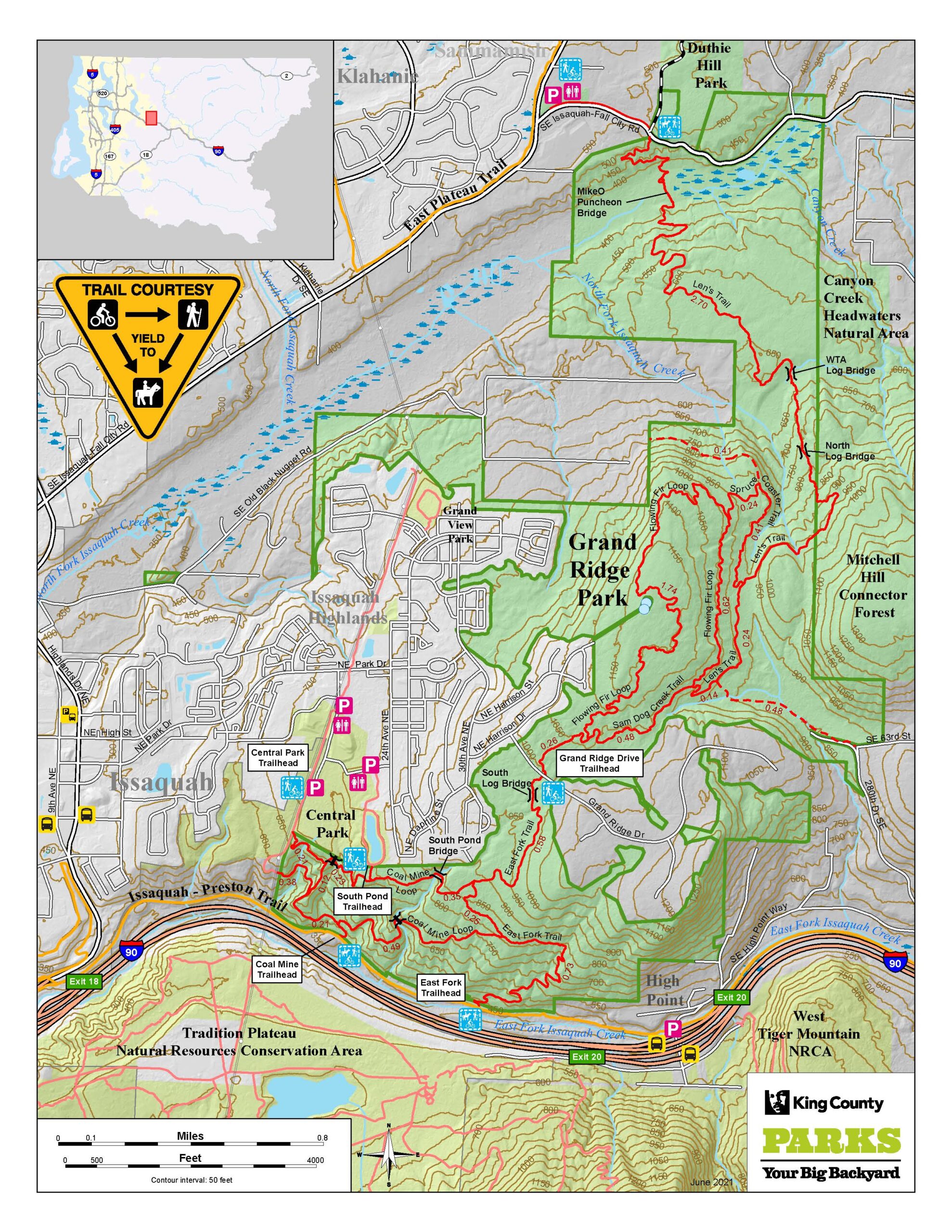
Grand Ridge Park winds through 1,200 acres of protected forest land. In Issaquah Highlands, the trail can be accessed from Grand Ridge Drive and Central Park. Map courtesy of King County Parks.
You don’t have to travel far to find adventure in Issaquah Highlands—some of the best hiking and biking trails can be found in our own backyard.
Grand Ridge Park is home to a network of scenic pathways just waiting to be explored. These trails aren’t just routes through the woods; they are community connectors, outdoor classrooms and wellness sanctuaries. They offer opportunities for fitness and recreation, bringing people together while encouraging a deeper connection with nature.
The centerpiece of the park is a seven-mile, multi-use trail that cuts through a variety of forest environments. It features moderate elevation gain and terrain that ranges from flat stretches to rolling hills, making it suitable for different skill levels and activities.
All types of outdoor recreation are enjoyed in Grand Ridge Park, from hiking and biking to horseback riding and mushroom foraging. Be sure to stay mindful of your surroundings and share the trail with fellow park users this summer.
A Trail Runner’s Dream
Runners seeking elevation gain and uninterrupted miles will find a natural gym in Grand Ridge Park. The soft dirt paths are gentle on joints, and the consistent elevation provides a steady challenge that trail runners crave. With plenty of twists and elevation changes, it’s a perfect route for interval hill training or long-distance endurance sessions.
Ride the Ridge
Grand Ridge is a popular spot for mountain bikers looking for a cross-country ride. While the trails here are less technical than nearby Duthie Hill Park—the region’s most renowned mountain bike skills park—the long, forested corridor offers excellent cross-training terrain for bikers who want distance and scenery.
Nature Walks & Wildlife Watching
For those looking for a slower-paced activity, Grand Ridge’s abundant natural diversity makes it a prime location for wildlife observation and nature walks. The northern edge of the park is home to red alder forests and wetlands, which provide crucial habitats for fish, birds and mammals. Keep your eyes open for signs of bears, cougars, chipmunks, owls and other wildlife.
Hiking in the summer might sound like a recipe for heat stroke, but here in Issaquah Highlands, it feels more like a refreshing escape than a sweaty workout. Towering Douglas fir and western red cedar trees line our trails, creating a natural canopy that softens the sun’s intensity.
During the week, the trails have a calm and quiet atmosphere that’s perfect for reflection, recharging or moving at your own pace. On weekends, the park comes alive with a mix of hikers, families and outdoor enthusiasts who make the most of our expansive trail system.
Get outside this summer and enjoy the trails, trees and sunshine just steps from home.

Take a guided hike with Issaquah Alps Trails Club (IATC) through Grand Ridge Park and see firsthand how they help protect this hidden treasure.
A Legacy of Advocacy, Nature and Community
Grand Ridge Park is more than just a beautiful stretch of forested trails and wildlife habitat. It’s a powerful reminder of what a community can achieve when it comes together to protect the land it loves.
About 20 years ago, the 2,223 acres that now make up Issaquah Highlands were classified as RA-5, a rural zoning designation. This type of zoning would have allowed just one home for every five acres, with each private property requiring its own well and septic system. If development had followed this plan, only 230 large homes would have been built across the hillside, likely blocking public access and carving up critical wildlife habitat.
Instead, thanks to visionary planning and grassroots advocacy, 80% of this land was preserved as protected parkland. The remaining 20% was thoughtfully developed into a walkable, high-density urban village with shops, homes and direct access to a network of trails.
This transformation didn’t happen by chance. It was the result of years of negotiations, strategic land use planning and the unwavering efforts of local advocates—especially Ken Konigsmark of the Issaquah Alps Trails Club (IATC).
He said one of the most dramatic turning points came when a “mystery buyer” emerged with plans to build a private mega-estate on 150 acres and demanded the right to enclose 200 additional acres of public land with an electrified fence.
Ken got involved when the buyer attempted to secure a private road through his own rural neighborhood. In response, he took the story public by alerting elected officials and mobilizing the community. His efforts played a crucial role in stopping the plan and ensuring that this vision of private exclusivity was never realized.
 Instead, the resulting development agreement between King County, City of Issaquah and Port Blakely was rooted in public good. Through a 4:1 land preservation to urban development agreement, Port Blakely was allowed to develop one acre of dense urban land for every four acres it donated for public use. In total, 1,242 acres were given to King County as protected parkland, with another 241 acres dedicated within the urban growth boundary for local parks.
Port Blakely agreed to two key Transfer of Density Rights (TDR) deals that helped preserve about 400 acres of forest, linking Grand Ridge to Preston and protecting Park Pointe near Tiger Mountain. This zoning move saved critical open space, ultimately shaping today’s trail network.
The final blueprint for Issaquah Highlands included 4,000 homes within just 20% of the land, plus 50 rural homes on 2.5-acre lots. To support conservation, Port Blakely donated 40 acres to King County Parks, helping preserve more natural space and meet environmental guidelines.
The result? A welcoming, connected and green Issaquah Highlands—with Grand Ridge Park at its heart.
Since 2000, the Washington Trails Association (WTA) has played a key role in shaping the trail system at Grand Ridge, initially linking old logging roads and user-built paths before constructing new trails to the north.
IATC and its local partners remain committed to protecting this legacy and to forging new paths ahead—literally and figuratively.
As we look to the future, we hope Grand Ridge continues to inspire new generations of advocates, explorers and trailblazers.
To learn more about the conservation efforts in our own backyard, IATC hosts quarterly hikes through Grand Ridge. Visit our calendar to see upcoming opportunities for exploration!